TI-83 Plus Programs
All files listed on this page are available according to the terms of the GNU GPL.
A ZIP archive with all programs and sources is also available.
BASIC Programs
- ATOMIC (1736 bytes)
- useful reference for element symbols, atomic numbers, and atomic masses
- BASECONV (387 bytes)
- converts numbers from one base to another, up to base 36
- DRAWMAND (729 bytes)
- plots the Mandelbrot set. This program can take a very long time to run (an hour, even with a large viewing window). You must adjust the graphing window beforehand to the section of the complex plane that you want to plot.
- FACTOR2 (162 bytes)
- factors an integer using trial division up to √n
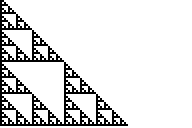
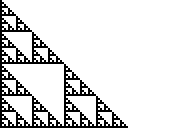
- FASTSIER (246 bytes) (screenshot)
- draws a level 5 Sierpinski triangle in about 5 seconds
- FIBLIST (134 bytes)
- generates a list of the Fibonacci sequence up to the specified term
- FIBPHI (151 bytes)
- calculates Fibonacci numbers using the powers-of-phi formula - works for any complex input
- HYPERANT (242 bytes)
- models Langton's Ant. Interestingly, the program only explicitly uses one bit to represent the ant's state (0=down/left, 1=up/right). The other bit of the ant's state ends up in the program counter (the address of part of memory the calculator is currently executing). In order to improve its speed, I made the program exitable only with the [ON] key.
- JOSEPHUS (227 bytes)
- calculates the last (m,n) Josephus survivor. Faster methods are used for n > 10 and n = 2, but may give incorrect results for very large m due to rounding errors. To use the slower, sure method for all n, change the first line of the program from
1→F to 0→F.
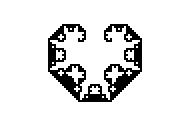
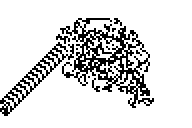
- LEVY (307 bytes) (screenshot)
- draws the Lévy C-curve of the specified level. Both programs, LEVY and LEVY2, are needed; to draw the fractal, run LEVY. For L ≤ 8, the fractal is drawn exactly.
- MARQUEE (255 bytes)
- scrolls input text across the screen
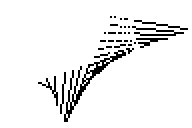
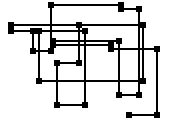
- MYSTERY (442 bytes) (screenshot)
- just like the Windows screensaver "Mystify your Mind"
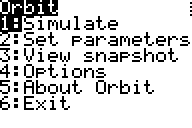
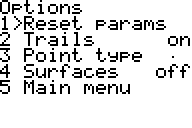
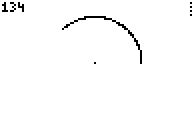
- ORBIT (2755 bytes) (screenshots: main menu / options / simulation)
- traces the orbit of a satellite around a much heavier body. All parameters are in SI units. The initial parameters are for the Earth's orbit around the Sun, with a time step of one day.
- PHI (170 bytes)
- calculates the value of the Euler phi function of a number n (the number of positive integers less than n that are relatively prime to n)
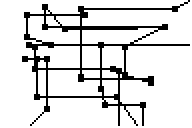
- PIPES2D (328 bytes) (screenshot)
- displays pipes in 2D
- PIPES3D (426 bytes) (screenshot)
- displays pipes in 3D
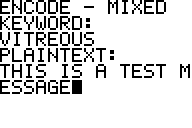
- POLYCIPH (1353 bytes) (screenshot)
- encodes and decodes alphabetical, decimal, alphanumeric, binary, hexadecimal messages using a "Vigenère"-like cipher - can use custom character sets
- PRIME (145 bytes)
- simple primality tester using trial division
- SIEVE (297 bytes)
- makes a list of prime numbers up to K using the Sieve of Eratosthenes (works up to K = 2000, but needs a lot of memory)
- STAINGLS (324 bytes)
- makes pretty designs that vaguely resemble intricate stained glass windows
- STAINGLX (496 bytes)
- another "screensaver" that looks sort of stained-glass-like
- TINYSIER (134 bytes) (screenshot)
- draws the Sierpinski triangle. The program itself is only 75 bytes, but it generates a 729-item list with the coordinates of points to draw. The nth-order list is given by: L0 = {0}; Ln+1 = {Ln, Ln, 2n + Ln}. The coordinates of points to draw are then (Ln(i), Ln(3n + 1 - i)), where 1 ≤ i ≤ 3n.
Assembly Programs
To run these programs, you must enter Asm(prgmPRGMNAME) at the home screen. (The Asm( command can be found in the Catalog.)
- ZANT (196 bytes) (source) (screenshot)
- models Langton's Ant. Interestingly, the program only explicitly uses one bit to represent the ant's state (0=up/left, 1=down/right). The other bit of the ant's state ends up in the program counter (the address of the part of memory the calculator is currently executing). This program runs about 3 times as fast as the BASIC version and can be stopped by pressing any key.
- ZINVERT (63 bytes) (source)
- inverts the graph screen
- ZLWRCASE (28 bytes) (source)
- enables/disables lowercase letters
- ZSIERPIN (71 bytes) (source) (screenshot)
- draws the Sierpinski Triangle way fast.